


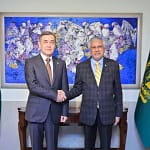
Dar meets SCO secretary general, reaffirms Pakistan’s commitment to advancing its objectives
July 15, 2026
US strikes Iran’s coastal defences in fresh salvo; Tehran again targets American assets in Gulf states
July 16, 2026
Deputy Prime Minister and Foreign Minister Ishaq Dar left for a two-day visit to China’s Shanghai on Thursday to sign an agreement for Pakistan to join the World Artificial Intelligence Cooperation Organisation (WAICO) as a founding member, the Foreign Office (FO) said.
China proposed the creation of WAICO last year for AI governance.
According to FO, Dar would also participate in the World Artificial Intelligence Conference (WAIC) 2026 during the visit and engage with other leaders to advance international AI cooperation and promote inclusive, equitable AI governance.
An earlier statement by the FO said that Dar would also hold a bilateral meeting with his Chinese counterpart, as well as meetings with other officials to discuss matters of mutual interest during the China trip.
“During his engagements, the Deputy Prime Minister/Foreign Minister will share Pakistan’s perspective on strengthening international cooperation in artificial intelligence, with particular emphasis on the priorities and development needs of the Global South,” the statement read.
It added that “he will underscore the importance of bridging the global AI divide, promoting equitable access to AI technologies, enhancing capacity-building, and ensuring that the benefits of AI contribute to sustainable development and shared prosperity for all”.
Last July, opening WAIC in Shanghai, Chinese Premier Li Qiang emphasised the need for governance and open-source development, announcing the establishment of a Chinese-led body for international AI cooperation.
During a four-day visit to China by Prime Minister Shehbaz Sharif in May this year, Pakistan expressed its support for “China’s initiative of establishing the World Artificial Intelligence Cooperation Organisation, believing that this represents a concrete step toward promoting the development of artificial intelligence for good and for all”.
Islamabad pledged to work with Beijing to “advance global governance and international cooperation” on AI.
What to expect at WAIC
Chinese President Xi Jinping is expected to outline an ambitious vision for China’s role in global AI governance at WAIC on Friday, as Huawei showcases its most advanced AI computing cluster yet in a sign of Beijing’s drive to build a domestic alternative to US technology.
Xi’s attendance at the annual WAIC for the first time underscores Beijing’s view of AI as both a driver of economic growth and a strategic technology in global competition.
Huawei’s Atlas 950 SuperPoD large-scale AI computing system will make its public debut during the forum in Shanghai. The launch is one of the clearest demonstrations yet of China’s efforts to assemble such systems without US giant Nvidia’s most advanced chips.
Designed for large-scale AI training and inference, the system links thousands of Huawei’s Ascend AI processors through high-speed interconnects so they operate as a single computing cluster.
DeepSeek’s latest V4 model has been adapted to run entirely on clusters built using Huawei’s Ascend chips, highlighting progress by Chinese firms in building AI ecosystems independent of US technology. Domestic media reported that Chinese chipmakers, including Biren and MetaX, would also release new “supernode” computing clusters.
The gathering comes as Washington and Beijing prepare for their first government-level AI talks under US President Donald Trump’s administration, turning WAIC from a technology showcase into an early test of how China intends to compete for influence over the rules governing AI worldwide.
The two rivals set out competing visions for AI governance at a UN AI dialogue last week, where Washington argued that sweeping regulation would stifle tech breakthroughs and Beijing framed its low-cost, open-source AI models as a public good that would bridge global AI inequality.
“Against this backdrop, WAIC has become more than a technology showcase; it is now a geopolitical stage where Beijing seeks to articulate its vision of AI as both a national priority and a diplomatic instrument,” wrote George Chen, chair of digital practice at the Asia Group.
The conference coincides with a High-Level Meeting on Global AI Governance in Shanghai, where progress on WAICO and implementing the Global AI Governance Initiative are expected to be announced.
Beijing is also expected to promote China’s open-source AI models as a low-cost alternative to Western offerings, arguing they can broaden access to the technology.
“The development of AI must never move toward a technological monopoly that walls itself in, but should always be anchored to the fundamental goal of serving humanity,” read a People’s Daily commentary this week.
Besides Chinese tech industry heavyweights, international leaders including UN Secretary General Antonio Guterres, Kazakh President Kassym-Jomart Tokayev and Thai Prime Minister Anutin Charnvirakul will attend WAIC.
Nine Turing Award and Nobel laureates, including deep learning pioneers Yoshua Bengio and Richard Sutton, will also attend, but there is little representation from major US tech firms.
Other product launches expected at the forum include AI agent smartphones from ZTE-owned Nubia and AI startup StepFun, according to Chinese media.
