


‘Reprehensible’: Pakistan condemns storming of Al Aqsa Mosque compound, raising of Israeli flag in its courtyard
April 21, 2026
2 Pakistani astronauts selected as candidates for China’s space programme
April 22, 2026‘At the request of CDF Munir, PM Shehbaz’, Trump announces extension in ceasefire until Iran submits proposal

Key developments:
- Trump has announced an extension in the ceasefire with Iran until Tehran submits a “unified proposal”; however, a naval blockade of Iranian ports will remain in place; JD Vance’s visit to Pakistan ’“not happening today”, says White House official
- PM Shehbaz thanks Trump for the decision, hopes both sides will be able to conclude “a comprehensive ‘Peace Deal’ during the second round of talks scheduled in Islamabad”
- No immediate official response by Iran on Trump’s announcement; decision by Tehran on participation in expected talks still awaited
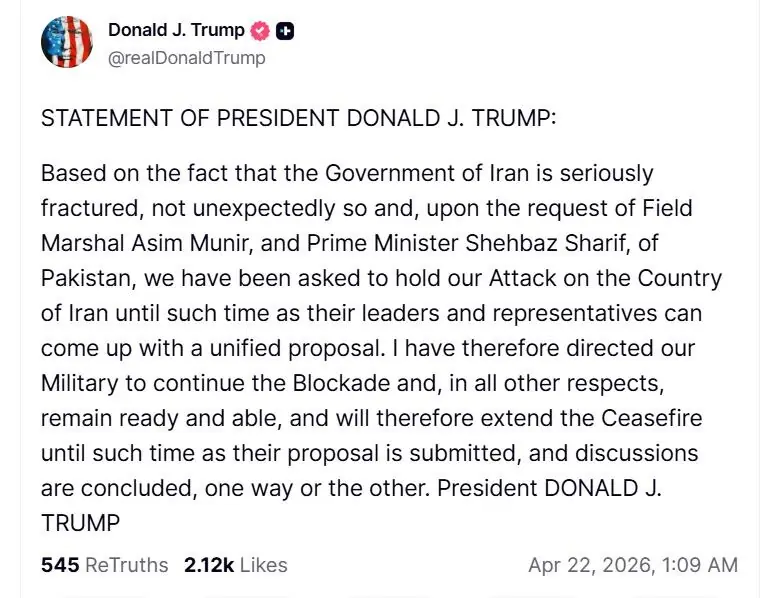
President Donald Trump announced on Wednesday that he was extending a ceasefire between the US and Iran until Tehran submitted a “unified proposal” and “discussions are concluded, one way or the other”.
“Based on the fact that the Government of Iran is seriously fractured, not unexpectedly so and, upon the request of Field Marshal Asim Munir, and Prime Minister Shehbaz Sharif, of Pakistan, we have been asked to hold our Attack on the Country of Iran until such time as their leaders and representatives can come up with a unified proposal.
“I have therefore directed our Military to continue the Blockade and, in all other respects, remain ready and able, and will therefore extend the Ceasefire until such time as their proposal is submitted, and discussions are concluded, one way or the other,” he posted on his Truth Social platform.
Trump’s statement came as the Pakistan-brokered ceasefire agreed on April 8 neared its deadline. The original deadline for the ceasefire was set for April 21 8pm ET, but Trump said on Monday that it was to continue till “Wednesday evening Washington time”. He had also said he would not extend the truce beyond that, but eventually extended it on Wednesday.
On the other hand, Pakistan Information Minister Attaullah Tarar said on Tuesday that the ceasefire was to end at 4:50am PST on April 22.
After Trump’s announcement of ceasefire extension, Prime Minister Shehbaz Sharif thanked the US president in a post on X.
“On my personal behalf and on behalf of Field Marshal Syed Asim Munir, I sincerely thank President Trump for graciously accepting our request to extend the ceasefire to allow ongoing diplomatic efforts to take their course,” he said.
The premier further stated that with the “trust and confidence reposed in [it], Pakistan shall continue its earnest efforts for negotiated settlement of conflict”.
“I sincerely hope that both sides will continue to observe the ceasefire and be able to conclude a comprehensive ‘Peace Deal’ during the second round of talks scheduled at Islamabad for a permanent end to the conflict,” he added.
There was no immediate official response from Iran on the extension announcement.
Uncertainty regarding talks
The developments took place amid anticipation of a second round of talks between Washington and Tehran in Islamabad to end hostilities — largely paused for now — that began with the US-Israeli strikes on Iran on February 28.
However, uncertainty prevailed over the possibility of talks amid mixed signals from Tehran and reports of delay in the departure of US Vice President JD Vance, who was expected to led the American delegation, to Islamabad on Tuesday.
Eventually, a White House official said after ceasefire extension that Vance’s trip to Pakistan would “not be happening today”.
“The trip to Pakistan will not be happening today. Any further updates on in-person meetings will be announced by the White House,” the official said in a statement.
For his part, Iran’s foreign ministry spokesperson Esmaeil Baghaei told Iranian state TV on Tuesday prior to Trump’s announcement that Tehran had not yet made a decision on whether to attend talks with the United States in Pakistan.
He said US moves against two Iranian vessels amounted to “piracy at sea and state terrorism” and questioned Washington’s seriousness in negotiating.
“The aggression against Iranian ships and the continued pressure indicate the continuation of the opposing side’s contradictory behaviour,” Baghaei said.
While he did not specify the incidents he was referring to, US military said earlier on Tuesday that its forces had boarded a tanker under sanctions for trading with Iran, the Tifani, in an operation that took place “without incident” on Tuesday. According to maritime tracker MarineTraffic, the Tifani was laden with 2 million barrels of crude oil loaded at Kharg Island.
On Sunday, the US Navy targeted and seized an Iranian-flagged ship, claiming it was attempting to evade its blockade of the Iranian ports.
Pakistan calls for ceasefire extension
Baghaei’s statement came hours after Information Minister Attaullah Tarar said that Pakistan was awaiting a formal response from the Iranian side regarding its participation in the second round of peace talks with the United States.
Pakistan remains in constant touch with the Iranian side, but a formal response from Tehran regarding participation in the Islamabad Peace Talks had not been received as of 7.30pm PST, the minister said on the social media platform X.
“The ceasefire ends at 4:50am PST, April 22. A decision from Iran to attend the talks before the end of the two-week ceasefire is critical,” he said.
“Pakistan has made sincere efforts to convince the Iranian leadership to participate in the second round of talks, and these efforts continue,” the information minister said.
Earlier in the day, Deputy Prime Minister and Foreign Minister Ishaq Dar had also urged the US and Iran to “consider extending the ceasefire and give dialogue and diplomacy a chance”, according to the Foreign Office (FO). He expressed these views in a meeting with US Chargé d’Affaires Natalie Baker, where the two discussed recent regional developments.
“DPM/FM underscored Pakistan’s consistent emphasis on dialogue and diplomacy as the only viable means to address challenges and achieve lasting regional peace and stability,” the FO said.
“He stressed the need for engagement between the United States and Iran, urged both sides to consider extending the ceasefire, and to give dialogue and diplomacy a chance,” it said.
Meanwhile, Baker conveyed the US’s appreciation for Pakistan’s constructive and positive role in promoting regional peace and facilitating dialogue, it added.
Trump expects ‘great deal’
Separately, US President Donald Trump touted the strong negotiation position of the country in talks with Iran to end the Middle East conflict.
“We’re going to end up with a great deal. I think they have no choice… We’re in a very, very strong negotiating position,” Trump told broadcaster CNBC.
He also reiterated that he did not want to extend a ceasefire with Iran.
“I don’t want to do that. We don’t have that much time,” Trump said when asked about the possibility of extending the ceasefire.
With the prospect of last-ditch further peace talks still up in the air, Trump had also said the US would resume its attacks on Iran if a deal is not struck with Tehran soon.
“I expect to be bombing because I think that’s a better attitude to go in with. But we’re ready to go. I mean, the military is raring to go,” he said.
Reasons for impasse
The first round of historic direct US-Iran talks, held in Islamabad on April 11 and 12, ended without an agreement, but also without a breakdown, as a Pakistan-brokered ceasefire remained in effect.
Pakistan initially positioned itself as a facilitator in the peace process between Tehran and Washington after the US and Israel launched attacks on Iran on February 28, setting off a conflict that gave rise to a global fuel crisis. Later, the White House and Iran acknowledged it as the “sole mediator” in the process.
After the first round of talks, Pakistan’s civil and military leadership engaged in feverish diplomacy, seeking to bring the US and Iran back to the negotiating table.
However, an impasse remains.
Iranian officials have questioned Washington’s commitment towards the talks. Iranian President Masoud Pezeshkian criticised “unconstructive and contradictory” signals by the US on Monday, saying they carried a “bitter message”.
Meanwhile, Iran’s foreign ministry said that the US was not serious about pursuing diplomacy, citing what it called “violations” of their two-week ceasefire. Its spokesman, Esmaeil Baqaei, said a US attack on an Iranian cargo ship, the US naval blockade on Iranian ports, and delays in implementing a ceasefire in Lebanon were all “clear violations of the ceasefire”.
Tensions in the Middle East further escalated following the seizure of an Iranian-flagged cargo vessel in the Gulf of Oman by US forces on Sunday. Trump described the move as enforcement of restrictions on Iranian ports, while Tehran called it “piracy” and responded with increased drone activity near US naval assets in the region surrounding the Strait of Hormuz.
The US maintained its blockade of Iranian ports, while Iran lifted and then reimposed its own blockade of the Strait of Hormuz.
Unrestricted navigation through the Strait of Hormuz has emerged as one of the issues at the core of the impasse between the US and Iran. Another point of contention is Washington’s demand for long-term commitments on Iran’s nuclear programme, including constraints on enrichment and safeguards against weaponisation.
