



PM Shehbaz thanks coalition partners, President Zardari for ‘full support’ on 27th Amendment
November 9, 2025
Sanaullah rubbishes alleged connection between Imran Khan and PM immunity clause
November 10, 2025PTI’s Zafar warns against altering ‘balance’ of 1973 Constitution as Senate debates 27th Amendment

PTI Senator Ali Zafar detailed during a Senate session on Sunday five points that he said constituted the fundamental spirit of the 1973 Constitution and warned that altering the “balance of these five pillars” could lead to “major chaos”.
The session was convened today — on a Sunday in a rare move — with a one-point agenda to deliberate on the bill for the 27th Constitutional Amendment.
The 26-page Constitution (Twenty-Seventh Amendment) Act, 2025 was tabled in the Senate yesterday amid the opposition’s outcry over the pace and scope of the proposed changes, just hours after its approval by the federal cabinet.
Senate Chairperson Syed Yousaf Raza Gilani presided over the session today, which began with the House remembering Allama Iqbal on his birth anniversary. Later, the house also passed a resolution in relevance to Iqbal Day.
During the session, PTI lawmakers had pictures of their party founder Imran Khan placed on their desks. At the beginning of the proceedings, a PTI leader raised an objection, to which Gilani replied that as per his ruling yesterday, the senator could bring his concerns to the Senate chairman’s office.
‘You cannot force a Constitution through bullets’
Addressing the upper house of the parliament, PTI Senator Ali Zafar outlined “five points” that he said formed the basic spirit of the 1973 Constitution and were now being “punctured” in the proposed 27th Amendment.
The first, he said, was that Pakistan was a federation with autonomous provinces. Secondly, the elected parliament had authority but was bound to the Constitution. Zafar said the third point was the fundamental rights provided therein, with courts formed to protect and implement them.
Fourth pillar of the Constitution, he added, was an independent judiciary to protect people’s rights and guarantee democracy, while the fifth one was civilian supremacy.
“If you alter this balance of five pillars even slightly through any amendment, the entire Constitution will be shaken and can result in major chaos,” Zafar warned.
At one point, Senator Sarmad Ali objected to the PTI bringing framed pictures and placards, pointing out that it was against the Senate rules, at which Gilani requested the opposition to refrain from doing so.
After presenting his arguments against the proposed legislation, Zafar urged the House to reject the bill for it and invited the treasury benches for further discussions.
“We can sit and think. There are a lot of options how to reduce the pendency of cases. We are ready to talk with you to consider amendments that will benefit the people, but we will not tolerate that you harm the public,” the PTI leader said.
During his speech, Zafar stressed that the Constitution was a contract between the state and the public, with a “spirit of its own”. He added that the document was a pledge that everyone, regardless of the region they hailed from, would live according to the laws.
“When you make any change in the Constitution, it is equal to tampering with the foundation of a building, and if you make any mistake, the entire building can collapse,” he contended.
Recalling that two dictators made amendments to the 1973 Constitution that “broke it”, Zafar highlighted that even they took “a lot of time” to be passed. He added that the “real spirit” of the 1973 Constitution was restored through the 18th Amendment in 2010.
The PTI senator underscored the need for a consensus on making any changes to the Constitution, contending that consensus and a two-thirds majority were separate things. “You cannot force a Constitution through bullets.”
Arguing that the PTI represented millions of people and was rejecting the 27th Amendment, Zafar said, “Respect the mandate of the people and kindly do not vote for this amendment.”
The lawyer asserted that those bringing any constitutional amendment should be “genuinely elected”, with no personal motives or wishes to stay in power. “This parliament, in my opinion with due respect, is not authorised to pass these amendments,” he added.
Zafar also claimed that the proposed changes related to provincial shares and rights under the 18th Amendment, which were dropped in the current draft, were a “face-saving for the PPP” so certain originally intended amendments could be passed.
He said the formation of a Federal Constitutional Court (FCC) under the new amendment would end the judiciary’s independence, and the president having the authority to appoint the judges could result in “selection of his choice”. He added that the increase in retirement age of FCC judges from 65 to 68 years was an “incentive for judges to become pliant judges”.
The PTI lawmaker highlighted the powers proposed for the FCC, including considering cases related to fundamental rights, and cautioned that the court not following previous judicial precedents would result in a “collapse of the system”.
Zafar further termed the provisions related to the transfer of judges without their consent as a “dangling sword” of moving them from one high court to another. “This will bring the judiciary under the executive’s total control,” he argued.
The senator also slammed lawyers citing the reason for the formation of FCC as pendency of cases, calling them “intellectually dishonest”, and asserted that the SC pendency only amounted to two per cent of cases pending across the country.
The PTI senator recalled how the parliament “systematically” reached debating the 27th Amendment today, highlighting the “slow, gradual but effective erosion of democracy and the Supreme Court”.
He then mentioned the Jan 13, 2024 verdict by a bench led by then-chief justice of Pakistan Qazi Faez Isa, which revoked the PTI’s electoral symbol a month before the general elections. He also recalled the SC’s ruling in the Article 63A case that struck down an earlier order and allowed the ballots of lawmakers who voted against party policy to be counted.
“It was as if the judiciary opened the gates for the 26th Amendment through this decision,” Zafar alleged, further claiming that the ruling coalition coerced some lawmakers to vote in 26th Amendment’s favour. The senator clarified that the PTI had never agreed to even the formation of constitutional benches, and had instead termed them “lesser of the two evils” compared to a constitutional court.
The senator then highlighted three verdicts handed by the SC’s constitutional benches — the reserved seats ruling that distributed seats earlier awarded to the PTI to the coalition partners, the order allowing the military trials of civilians, and the ruling in the judges’ transfer case to allegedly “control the Islamabad High Court”.
The upper house of the parliament broke into a loud exchange at one point, when Gilani gave the floor to PTI’s Faisal Javed to speak but a lawmaker interjected. “Who are you to say this to me when the chairman has allowed me to speak?” Javed asked.
Necessary to bring some improvements in judicial system: PML-N’s Pervaiz Rashid
From the treasury benches, PML-N Senator Pervaiz Rashid regretted that Barrister Zafar had presented just one side of the picture, “which is likeable to them”. Zafar did not mention anything about the effort in the past to “convert the judiciary into a tool of a political party”, Rashid said.

The PML-N lawmaker said the members from the opposition benches had spoken on just one point of the proposed amendment, which pertained to the judiciary. He added that he would take it as their acceptance of the rest of the clauses of the proposed amendment.
Rashid further stated that he would have been pleased had opposition members also participated in the meetings of the standing committees so that their input would have been included in their reports and subsequently discussed in the house.
Meanwhile, PPP Senator Syed Masroor Ahsan said the PTI lawmakers were “confused”, which led to an eruption of responses from the opposition benches.
In his fiery speech, Ahsan stated that the PPP had “seen bodies” of its slain leaders, including late prime minister Zulfikar Ali Bhutto, his daughter and ex-premier Benazir, Murtaza Bhutto, Shahnawaz Bhutto and Nusrat Bhutto.
“You are in the parliament, you are sitting with politicians, you are also ready to enact legislation with political individuals, but you are willing to talk with someone else only,” he said while addressing the PTI.
The PPP senator also said he wanted the opposition to take part in the meetings of the standing committees, just as they were participating in the Senate proceedings.
You cannot end judiciary’s independence because of past decisions: Hamid Khan
In his speech, PTI Senator Hamid Khan took exception to the manner in which the government was trying to amend the Constitution.
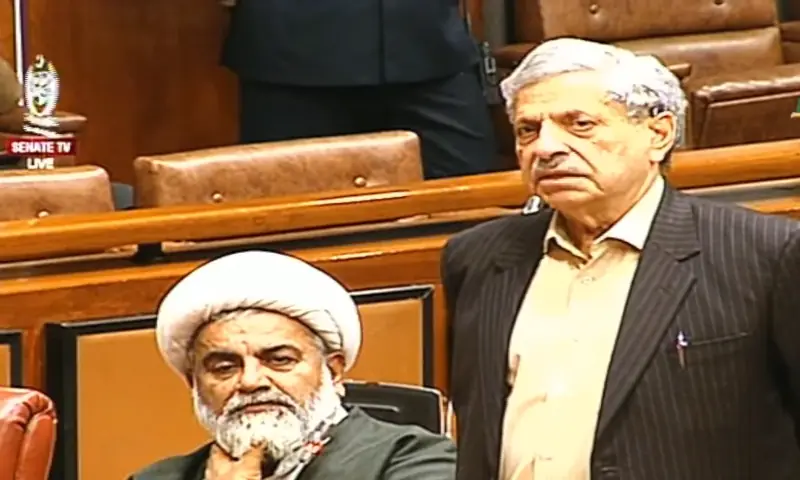
“Constitutional amendments are not promulgated in this manner. You first reach a consensus and then amend the constitution,” he asserted.
Khan further stated that he considered the 26th Amendment “the death of the Constitution” and the effort to promulgate the 27th Amendment was akin to an “effort to bury the Constitution”.
“Both these amendments are truly something to be ashamed of.”
He went on to say that some political parties had “complaints that when the judiciary was liberated in the true sense, it issued orders to disqualify two prime ministers”.
“But this does not mean that they (political parties) get personal […] They [shouldn’t try to] put an end to the same Constitution under which [the prime ministers] were disqualified, to bring about the end of that same judiciary that disqualified them,” he added.
Khan clarified that he understood that those decisions were “controversial to some extent” and he was not supporting those decisions. “But this does not mean that you end the independence of the judiciary because of judges’ past decisions. […] Both right and wrong decision are made in history, but they don’t become a reason to ban courts.”
He questioned that if the existing judicial system ceased to exist, “who will you go to for your fundamental rights?”.
“We are at a historical moment [at present]. And if, for any reason, […] we take a step that results in the destruction and distortion of the Constitution, all of us will have to face its consequences — those who will vote [in favour of it] and the coming generations as well,” he warned.
PTI Senator Azam Swati, addressing the Upper House with a black ribbon tied around his arm, hailed the “amazing” 1973 Constitution introduced by Bhutto and other political leaders, adding that the 27th Amendment would ruin it.
Swati contended that the Statement of Object and Reasons in the proposed bill did not even address the amendments suggested in it, terming them “vague and incomplete”. He further said that the SC’s original jurisdiction under Article 184(3) had been torn into pieces, and that Articles 175 and 191 did not make up for it.
“May God give you long life, this (legislation) will bite you back one day, and you will admit that you made a major mistake,” the PTI leader said.
PTI’s Mohsin Aziz also questioned the “haste” in passing the Amendment, adding that certain “informed” individuals already knew that this legislation would be introduced.
He said most of the amendments made so far were “benign”, while certain were major such as the 13th, 18th and 25th. “So why is there a need for two amendments in just two years?” he asked.
The PTI lawmaker defended the speeches given by Zafar and Hamid, saying they were not political. “They spoke as opposition not for the sake of opposition, but for the sake of betterment of this country.”
He further said, “Do not be in haste. If there are good amendments, we will definitely sit proudly with you and agree on it.”
‘Are non-Muslims not Pakistanis?’
Balochistan Awami Party Senator Danesh Kumar also spoke during the session, raising the question that when amendments were proposed, why did they not address the lack of minorities in the federal cabinet.
“When you were proposing amendments to Article 130 and expanding the size of the cabinet, why did you not suggest that at least one member be from the minorities?” he asked, addressing Deputy Prime Minister Ishaq Dar.
“There are no minority members in KP or Balochistan. The only minority member here is a state minister, not a federal minister,” he added.
Kumar then mentioned that according to the Constitution, the prime minister and president have to be Muslim.
“In Article 91, it says the prime minister can only be Muslim. Are we non-Muslims not Pakistani?” he asked. “If you are bringing amendments, then amend these things.”
Later, the Senate session was adjourned until 11am tomorrow.
‘Govt’s haste calls into question the intention behind moving the bill’
Separately, the Human Rights Commission of Pakistan (HRCP) issued a statement, deploring “the manner in which the 27th Amendment to the Constitution is being tabled in Parliament”.
“The government’s haste—including the absence of any meaningful consultation with the political opposition, the wider legal fraternity and civil society—calls into question the very intention behind moving this amendment bill.
“Its reported content, with numerous changes designed to reconfigure the judicial system, the office-specific concentration of power ceding more civilian space, and lifelong immunity to certain state offices, has alarmed constitutionalists, the legal fraternity, human rights defenders and many others who believe in the independence of the judiciary and the tenets of civilian supremacy in a democracy,” the statement posted on X said.
It added that the HRCP planned to hold an urgent consultation with a wide range of stakeholders to examine the proposed amendment and its “far-reaching impact on the country’s polity and society”.
Meanwhile, Karachi Press Club (KPC) President Fazil Jamili posted on X that the “ rushed 27th Amendment through Parliament, lacking the meaningful consultation, is deeply alarming“.
“We at KPC deplore the proposed judicial reconfiguration, concentrated power, and lifelong immunity, which gravely threaten the independence of the judiciary and civilian supremacy,” he added.
