



Trump fires Pam Bondi as US attorney general, White House official says
April 2, 2026
At least 5 killed as heavy rain lashes Karachi; city administration declares emergency
April 2, 2026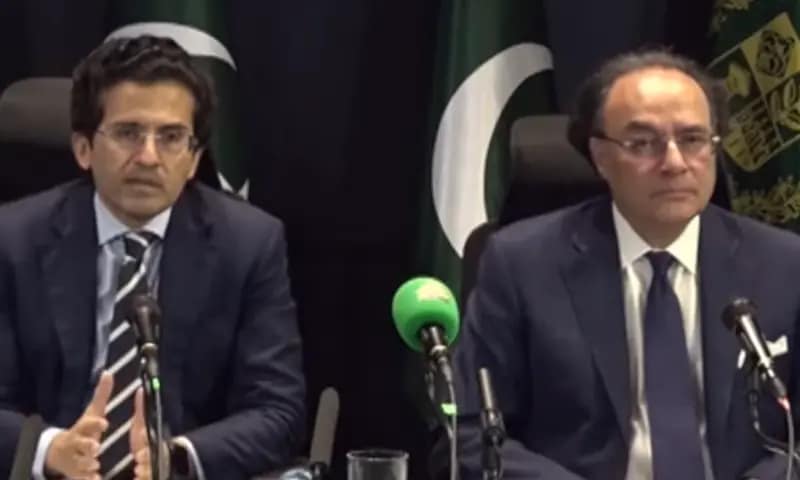
Petroleum Minister Ali Pervaiz Malik announced on Thursday that the price of petrol was being raised to Rs458.4 per litre and that of high-speed diesel (HSD) to Rs520.35 per litre.
He made the announcement while addressing a press conference alongside Finance Minister Muhammad Aurangzeb.
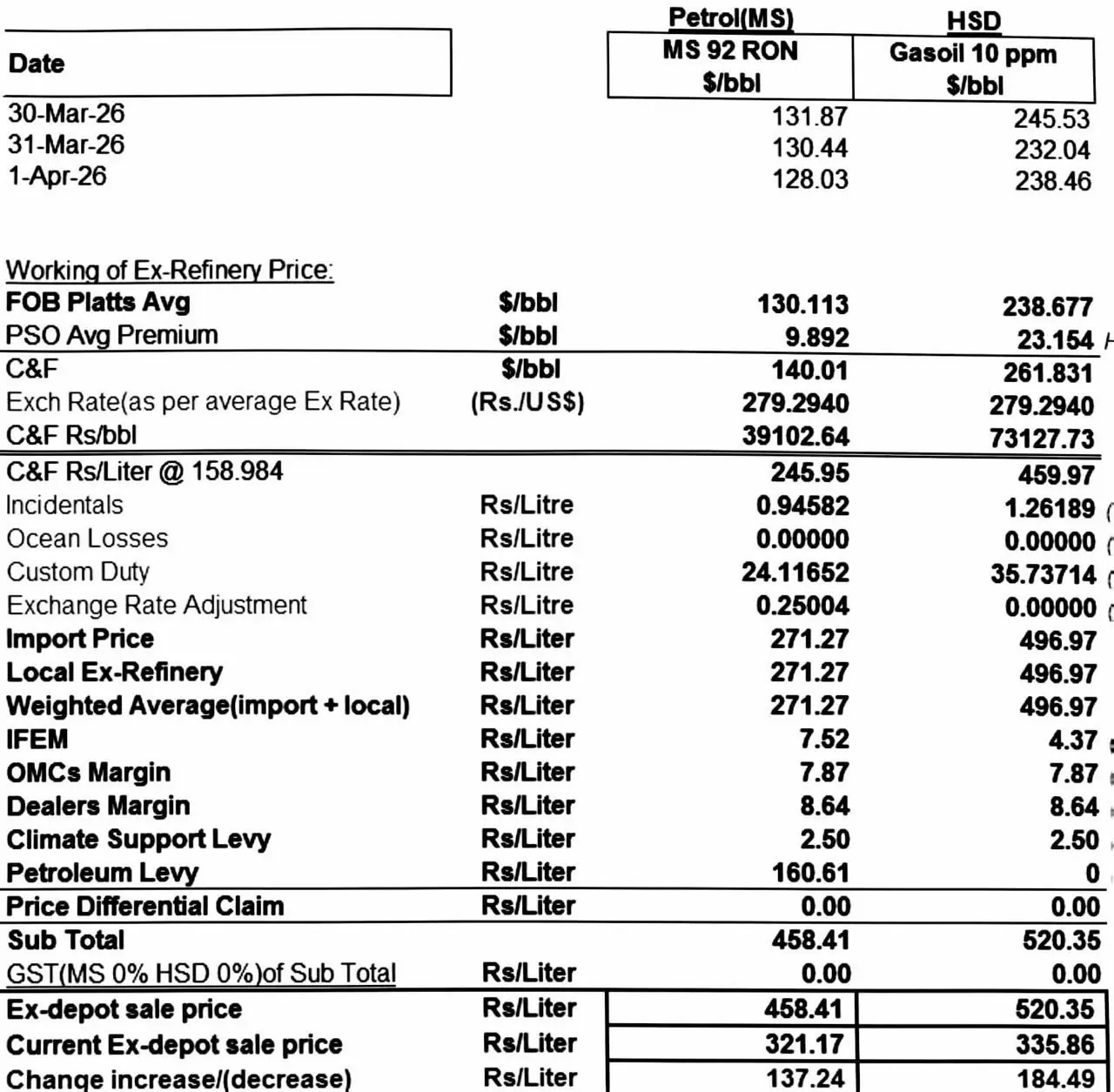
Soon after his announcement, the energy ministry also notified the new prices, with petrol’s price being raised by Rs137.24 per litre and diesel’s by Rs184.49 per litre.
The government also increased kerosene prices by Rs34.08 per litre to Rs457.80 per litre.
Malik said the new prices would be effective from Friday.
The latest hike comes amid a global fuel crisis resulting from the US-Israeli war on Iran, which began on February 28.
It was announced around a week after Prime Minister Shehbaz Sharif said he had rejected a third recommendation for an increase of Rs95 per litre in the price of petrol and Rs203 per litre in that of HSD since the war began.
Previously, the PM said he had rejected an increase of Rs76 per litre in the price of petrol Rs177 per litre in that of HSD. The premier had also said that he had rejected a similar recommendation earlier as well, following a hike in oil prices in the international market on March 13.
Though after the war began, the government had hiked petroleum products’ prices by Rs55 per litre on March 6 and announced unprecedented austerity measures on March 9 in the first steps to deal with the situation.
Targeted subsidy initiatives
Speaking after Malik at the press conference, Finance Minister Aurangzeb said the government was announcing a targeted subsidy programme, adding that it had been decided that a subsidy of Rs100 per litre would be given for two-wheelers. He said there would be a cap of 20 litres for every month for this initiative, adding that the relief would be given for the next three months.
Similarly, small farmers would be provided a one-time Rs1,500 per acre subsidy as agriculture contributed 24pc of the gross domestic product and was key to food security.
On HSD-run inter-city and goods transport, Rs100 per liter subsidy would be provided and its price would be reviewed every month, he said. In this regard, Rs70,000 direct support would given for trucks carrying almost 80-85pc of food items, the finance minister said. Large transport vehicles would be given Rs80,000 per month while inter-city passenger or public service vehicles would be provided Rs100,000 per month to ensure that fares remained stable.
He said the federal government would also give subsidy to facilitate low-income segments travelling through trains.
The finance minister, however, did not explain and when the subsidies would be rolled out.
Aurangzeb also said it had been agreed that after consultation with the provinces, revised timings for markets would be “advised” next week.
‘Difficult and responsible’ decisions
At the outset of the press briefing, Malik expressed gratitude to President Asif Ali Zardari, chief ministers of all provinces and the leadership of the ruling party’s allies for their guidance at this “critical time”.
He said energy prices had skyrocketed in the international market due to the ongoing Middle East war. “It has not just engulfed the entire region but the entire world as well,” he added.
The minister stressed the need for discipline and unity at this time, expressing the hope that the “difficult and responsible” decisions that the government had taken today would be seen in the context of the situation in the Middle East, in which the Pakistan government had no role.
He regretted that the war had also affected the progress made for the stability and prosperity of Pakistan’s economy over the last one to two years.
Given the situation, he highlighted the need for de-escalation efforts on the diplomatic front.
He then pointed out that crude oil prices in Dubai and Oman markets, from where Pakistan procured 80 per cent of its energy supplies, had increased to record highs. Crude oil and diesel prices, he added, had reached historic highs, crossing the $250 dollar mark.
Malik said Prime Minister Shehbaz Sharif had tried to shield the people from the impact of these prices by interventions such as austerity measures and cuts in development budgets.
He said the federal government had spent Rs129 billion since March 1 to “protect the people”, adding that meanwhile, arrangements for alternative energy supply lines also had to be made due to the disruption of traffic in the Strait of Hormuz.
“We tried to handle this matter in a better manner by means of austerity measures and through diplomacy,” he said.
The minister said the government had been successful on this front to some extent, pointing out that even countries wealthier than Pakistan had been struggling in these times.
Malik said the government had taken timely decisions, which ensured no disruptions in fuel supplies, acknowledging however that the hike in prices would have caused difficulties for the people.
He said Pakistan had some fiscal constraint and was also bound by some international agreements.
Moreover, he continued, the country’s economic stability could not be imperilled. Hence, he said, the government had decided to move away from blanket subsidy and focus this relief towards just the “weak segments” who needed it.
He said a meeting was held today, where the prime minister and military leadership were also present. It was decided at the meeting that instead of giving a blanket cover, “the focus will have to be sharpened”, he added.
