


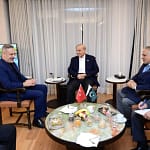
PM Shehbaz arrives in Turkiye on third leg of tri-nation tour, holds meeting with FM Fidan
April 16, 2026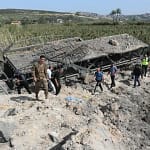
10-day ceasefire between Israel, Lebanon takes effect
April 16, 2026
US President Donald Trump said on Thursday that if a deal with Iran to end the war was reached and signed in Islamabad, he might go there, claiming that Iran had agreed to almost everything.
He also said that the US and Iran were “very close” to signing a peace deal.
Trump struck an optimistic tone about Iran as he spoke with reporters on the White House lawn on his way to a trip to Nevada and Arizona.
Pakistan’s civil and military leadership has been engaged in feverish diplomacy, seeking to bring the US and Iran back to the negotiating table after the Islamabad Talks over the weekend yielded no result. Now, there are reports that the negotiating teams from the US and Iran could return to Islamabad.
The talks were held as a Pakistan-brokered two-week ceasefire between Washington and Tehran remained in effect. The ceasefire paused hostilities that began with the US-Israeli strikes on February 28.
During the conversation at the White House, Trump was asked if he would go to Pakistan to seal the deal himself, to which he replied: “I would go to Pakistan. Pakistan has been great. They have been so great … if the deal is signed in Islamabad, I might go.”
He added that Chief of Defence Forces and Chief of Army Staff Field Marshal Asim Munir, who is visiting Iran as part of the mediation effort, had been great, and so had been Prime Minister Shehbaz Sharif.
He also said he could extend the US-Iran ceasefire set to expire next week, but may not need to do so.
Moreover, without providing evidence, he claimed Iran had agreed to give up the enriched uranium believed buried from US-Israeli airstrikes last year.
Trump is pushing for a deal with Iran in which Tehran would give up its nuclear programme.
“We had to make sure that Iran never gets a nuclear weapon … They’ve totally agreed to that. They’ve agreed to almost everything, so maybe if they can get to the table, there’s a difference,” he claimed. “They’ve agreed to give us back the nuclear dust,” he said, using his name for the enriched uranium stockpile.
Asked when the next round of in-person US-Iran meeting would be held, he replied, “Maybe over the weekend.” On the possibility of no deal between Iran and the US, he said, “If there’s no deal, fighting resumes.”
When asked if he was still interested in acquiring Iranian oil, Trump replied, “We’ll see.”
“We have a really good relationship with Iran right now, as hard as it is to believe,” Trump said. “I think it’s a combination of four weeks of bombing and a very powerful blockade.”
He said the US had a “very good relationship” with Iran’s leaders, expressing confidence that an agreement would be reached.
“We’re close to a deal. Would I accept? Yeah, I would do that,” he told reporters.
“We’re close to a deal, we’re getting along very well with the new Iranian leaders. It really is a regime change; these are people who are a lot different than the people we were dealing with in the beginning.
“We have a very good relationship, and I think there is a very good chance we’re going to make a deal,” he added.
On Tuesday, Trump said talks between Washington and Tehran could resume over the next two days and that “we’re more inclined to go” to Pakistan for negotiations. But, he had added that he would not participate in the negotiations.
On Wednesday, the White House said the US was discussing a possible second round of peace talks with Iran in Islamabad and was optimistic about reaching a deal.
Meanwhile, Pakistan’s civil and military leadership engaged in diplomacy, with PM Shehbaz embarking on a four-day tour to Riyadh, Doha and Istanbul and Field Marshal Munir leading a delegation to Tehran.
A source close to the delegation said FM Munir carried a message from Washington, including updates linked to efforts to secure a ceasefire in Lebanon, which was announced today.
Iran was awaiting an announcement of the ceasefire before deciding its response to the message relayed through Pakistan, the source added, underlining how developments in Lebanon remain tied to the broader negotiation track. The Iranian side was reportedly also judging whether or not US would stand by the commitments being made in the proposal.
Meanwhile, Trump said the war was “close to over” and hinted at another round of talks.
Push for talks
Pakistan, after the end of the talks in Islamabad on April 11-12, moved swiftly to consolidate international support.
Deputy Prime Minister and Foreign Minister Ishaq Dar has recently held a series of calls with his counterparts, including Britain’s Yvette Cooper, China’s Wang Yi, Turkiye’s Hakan Fidan, Saudi Arabia’s Prince Faisal bin Farhan and Egypt’s Badr Abdelatty.
Across these engagements, Pakistan conveyed a consistent message that all parties to the conflict must uphold the ceasefire and that dialogue remains the only viable path forward. International partners responded positively.
Diplomatic sources said these engagements helped build a broad, if informal, coalition aimed at sustaining the process and buying time before the April 22 deadline.
The objective was to secure either an extension of the ceasefire or a return to technical-level engagement that could prepare the ground for a second political round.
Since the Islamabad talks, the intermediaries have helped exchange messages between the US and Iran on the outstanding issues, hoping to convince both sides to extend the truce by at least 45 days.
