


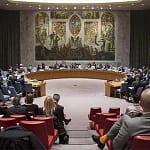
UNSC to meet on Monday amid mounting alarm over US action in Venezuela, concerns about risks to international system
January 4, 2026
3 on-duty traffic policemen martyred in firing by suspected terrorists in KP’s Lakki Marwat
January 4, 2026
Venezuelan President Nicolas Maduro was in a New York detention centre on Sunday after President Donald Trump ordered a US raid to capture the South American leader and take control of the country and its vast oil reserves.
As part of the dramatic operation early on Saturday that knocked out electricity in parts of Caracas and included strikes on military installations, US Special Forces seized Maduro and his wife, Cilia Flores, and transported them via helicopter to a US Navy ship offshore before flying them to the US.
“We will run the country until such time as we can do a safe, proper and judicious transition,” Trump told a press conference at his Mar-a-Lago resort in Florida.
For months, his administration criticised Maduro, 63, alleging his involvement in shipping drugs to the US. It ramped up pressure with a massive military build-up in the Caribbean and a series of deadly missile attacks on alleged drug-running boats.
Maduro in New York
A plane carrying Maduro landed near New York City on Saturday night, and he was helicoptered to the city before being taken by a large convoy to the Metropolitan Detention Centre in Brooklyn under a heavy police guard.
Images released by US authorities showed the leader handcuffed and blindfolded during the flight, and later being led down a hallway at the offices of the US Drug Enforcement Administration, where he was heard wishing a “happy New Year.”
Indicted on various federal charges, including narco-terrorism conspiracy, Maduro expected to make an initial appearance in Manhattan federal court on Monday, according to a Justice Department official.
It is unclear how Trump plans to oversee Venezuela. US forces have no control over the country, and Maduro’s government appears not only to still be in charge but to have no appetite for cooperating with Washington. Maduro’s vice president, Delcy Rodriguez, appeared on Venezuelan television on Saturday afternoon with other top officials to decry what she called a kidnapping.
We demand the immediate release of President Nicolas Maduro and his wife Cilia Flores,” Rodriguez said, calling Maduro “the only president of Venezuela.” A Venezuelan court ordered Rodriguez to assume the position of interim president.
Trump has also indicated US troops could be deployed in Venezuela, saying Washington is “not afraid of boots on the ground.”
One aspect that became clearer was Trump’s interest in Venezuela’s vast oil reserves.
“We’re going to have our very large United States oil companies … go in, spend billions of dollars, fix the badly broken infrastructure,” he said.
“We’ll be selling large amounts of oil.”
Trump dismisses opposition leader
US-backed opposition leader Maria Corina Machado, who won last year’s Nobel Peace Prize, posted on social media that “the hour of freedom has arrived.” She called for the opposition’s 2024 election candidate, Edmundo Gonzalez Urrutia, to “immediately” assume the presidency.
But Trump was surprisingly cold about expectations that Machado could become Venezuela’s new leader, saying she doesn’t have “support or respect” there.
Instead, he touted Rodriguez, saying “she’s essentially willing to do what we think is necessary to make Venezuela great again.” Rodriguez poured cold water on that, demanding Maduro’s release and vowing to “defend” the country.
Mamdani opposes ‘pursuit of regime change’
New York City Mayor Zohran Mamdani said on Saturday he had called Trump and voiced his opposition to a “pursuit of regime change” in Venezuela.
“I called the president and spoke with him directly to register my opposition to this act and to make clear that it was an opposition based on being opposed to a pursuit of regime change, to the violation of federal international law,” he said while speaking to reporters.
Separately, in a post on social media platform X, he said he had been briefed about the US military capture of Venezuelan President Maduro and his wife, as well as their planned imprisonment in federal custody here in New York City.
“Unilaterally attacking a sovereign nation is an act of war and a violation of federal and international law.
“This blatant pursuit of regime change doesn’t just affect those abroad, it directly impacts New Yorkers, including tens of thousands of Venezuelans who call this city home. My focus is their safety and the safety of every New Yorker, and my administration will continue to monitor the situation and issue relevant guidance,“ he added.
China condemns US action
Venezuela ally China initially said it “strongly condemns” the US operation, while France warned a solution cannot “be imposed from outside.”
China’s foreign ministry later said on Sunday the United States should immediately release Maduro and his wife and resolve the situation in Venezuela through dialogue and negotiation.
The ministry said in a statement on its website that the United States should also ensure the personal safety of Maduro and his wife, saying that their deportation violated international law and norms.
United Nations Secretary General Antonio Guterres said he was “deeply concerned that the rules of international law have not been respected.”
At Venezuela’s request, the UN Security Council will meet on Monday to discuss the crisis.
While many Western allies oppose Maduro and say he stole Venezuela’s 2024 election, Trump’s boasts about controlling the nation and exploiting its oil revived painful memories of past US interventions in Latin America, Iraq and Afghanistan.
Some legal experts questioned the legality of an operation to seize the head of state of a foreign power, while Democrats who said they were misled during recent Congress briefings demanded a plan for what is to follow.
Trump said as part of the takeover, major US oil companies would move back into Venezuela, which has the world’s largest oil reserves, and refurbish badly degraded oil infrastructure, a process experts said could take years.
Blackout and bombing
Venezuelans had been bracing for attacks as US forces spent months massing off the coast.
Caracas residents woke to explosions and the whir of military helicopters around 2am local time (0600 GMT). Air strikes hit a major military base and an airbase, among other sites, for nearly an hour.
The top US military officer, General Dan Caine, said 150 aircraft took part in the operation, supporting troops who choppered in to seize Maduro with the help of months of intelligence into his daily habits — down to “what he ate” and what pets he kept.
Maduro and his wife “gave up” without a struggle, and there was “no loss of US life,” he said.
Venezuelan authorities have yet to release casualty figures. But Trump told the New York Post that “many” Cubans in Maduro’s security detail were killed.
Within hours of the operation, Caracas had fallen eerily quiet, with police stationed outside public buildings and the smell of smoke drifting through the streets.
Shifting justifications
The US and numerous European governments did not recognise Maduro’s legitimacy, saying he stole elections in 2018 and 2024.
Maduro — in power since 2013 after taking over from leftist mentor Hugo Chavez — long accused Trump of seeking regime change in order to control Venezuela’s oil reserves.
Trump has offered several justifications for the aggressive policy toward Venezuela, at times stressing illegal migration, narcotics trafficking and oil.
But he had previously avoided openly calling for regime change.
Several members of Congress quickly questioned the legality of the operation. But Trump’s key ally Mike Johnson, top Republican in the House of Representatives, said it was “justified.”
